Inputs and Outputs Structure
InputsOutputsStructure.RmdUnderstanding Input Parameters
The EPIC model uses configuration files to define all input
parameters. Default input values are loaded from JSON configuration
files (e.g., config_canada.json or
config_us.json). You can retrieve these values using
get_input().
Retrieving Input Parameters
# Get default inputs for Canada (default)
library(epicR)
#> epicR: Using config files from: /home/runner/.config/R/epicR/config
#> To reset configs to defaults, use: reset_user_configs()
#>
#> Attaching package: 'epicR'
#> The following object is masked from 'package:stats':
#>
#>     simulate
input <- get_input()

# Get inputs for US
input_us <- get_input(jurisdiction = "us")

# The function returns a nested list with three components:
# - values: The actual parameter values used in simulation
# - help: Descriptions of what each parameter means
# - ref: Literature references for each parameter
Input Structure Overview
The input$values list contains the following main
categories:
| Category | Description |
|---|---|
global_parameters |
Time horizon, age ranges, discount rates, cohort settings |
agent |
Population demographics, mortality, height/weight distributions |
smoking |
Smoking initiation, cessation, relapse rates, mortality factors |
COPD |
COPD prevalence and incidence equations |
lung_function |
FEV1 baseline, decline, and prediction equations |
exacerbation |
Exacerbation rates, severity, duration, and mortality |
symptoms |
Cough, phlegm, dyspnea, wheeze probabilities |
outpatient |
GP visit rates |
diagnosis |
Diagnosis probabilities, case detection parameters |
medication |
Medication adherence, effectiveness, costs, utilities |
cost |
Healthcare costs (exacerbations, maintenance, visits) |
utility |
Quality of life utilities by disease stage |
manual |
Advanced calibration parameters |
Detailed Input Categories
Global Parameters (global_parameters)
Controls overall simulation settings.
| Parameter | Description | Default (Canada) |
|---|---|---|
age0 |
Starting age in the model | 40 |
time_horizon |
Model time horizon in years | 20 |
discount_cost |
Annual discount rate for costs | 0 |
discount_qaly |
Annual discount rate for QALYs | 0.03 |
closed_cohort |
0 = open population (new agents enter), 1 = closed cohort | 0 |
# Example: Modify global parameters
input <- get_input()
input$values$global_parameters$time_horizon <- 10
input$values$global_parameters$discount_cost <- 0.015
input$values$global_parameters$discount_qaly <- 0.015

results <- simulate(input = input$values)
#> === EPIC Simulation Configuration ===
#> Jurisdiction: CANADA
#> Time horizon: 10 years
#> Number of agents: 60,000
#> Event recording: DISABLED
#> =====================================
#>
#> Starting simulation...
#> No active session - initializing automatically
#> Initializing the session
#> Working directory: /home/runner/work/epicR/epicR/vignettes
#> Running EPIC model (with custom input parameters)
#> Record mode: record_mode_none (0)
#> Note: No events will be recorded. Use record_mode_event (2) or record_mode_agent (1) to record events.
#> Simulating 60000 base agents: 10% 20% 30% 40% 50%
#> 60% 70% 80% 90% 100%
#> Simulation completed in 1.5 seconds
#> Collecting results...
#> Collecting extended results...
#> Terminating the session
#> Done!
Agent Demographics (agent)
Defines the simulated population characteristics.
| Parameter | Description |
|---|---|
p_female |
Proportion of females in the population (default: 0.5) |
height_0_betas |
Regression coefficients for baseline height (meters) |
height_0_sd |
Standard deviation of baseline height |
weight_0_betas |
Regression coefficients for baseline weight (kg) |
weight_0_sd |
Standard deviation of baseline weight |
height_weight_rho |
Correlation between height and weight |
p_prevalence_age |
Age distribution at baseline (111 values, ages 0-110) |
p_incidence_age |
Age distribution for new population entering model |
p_bgd_by_sex |
Life table - annual probability of background death by age and sex |
l_inc_betas |
Log-rate of new population incidence |
ln_h_bgd_betas |
Modifiers for background mortality (time trends, etc.) |
# Example: Change population sex distribution
input <- get_input()
input$values$agent$p_female <- 0.52  # 52% female

results <- simulate(input = input$values)
#> === EPIC Simulation Configuration ===
#> Jurisdiction: CANADA
#> Time horizon: 20 years
#> Number of agents: 60,000
#> Event recording: DISABLED
#> =====================================
#>
#> Starting simulation...
#> No active session - initializing automatically
#> Initializing the session
#> Working directory: /home/runner/work/epicR/epicR/vignettes
#> Running EPIC model (with custom input parameters)
#> Record mode: record_mode_none (0)
#> Note: No events will be recorded. Use record_mode_event (2) or record_mode_agent (1) to record events.
#> Simulating 60000 base agents: 10% 20% 30% 40% 50%
#> 60% 70% 80% 90% 100%
#> Simulation completed in 3.2 seconds
#> Collecting results...
#> Collecting extended results...
#> Terminating the session
#> Done!
Smoking Parameters (smoking)
Controls smoking behavior and its health effects.
| Parameter | Description |
|---|---|
logit_p_current_smoker_0_betas |
Probability of being current smoker at creation |
logit_p_never_smoker_con_not_current_0_betas |
Probability of being never-smoker (given not current) |
minimum_smoking_prevalence |
Floor for smoking prevalence |
mortality_factor_current |
Mortality multipliers for current smokers by age group |
mortality_factor_former |
Mortality multipliers for former smokers by age group |
pack_years_0_betas |
Pack-years regression at baseline |
pack_years_0_sd |
Standard deviation of pack-years |
ln_h_inc_betas |
Log-hazard of smoking initiation/relapse |
ln_h_ces_betas |
Log-hazard of smoking cessation |
smoking_ces_coefficient |
Decay rate for cessation treatment effect |
smoking_cessation_adherence |
Proportion adhering to cessation treatment |
# Example: Increase smoking cessation rate
input <- get_input()
# The first coefficient is the intercept - increasing it increases cessation rate
input$values$smoking$ln_h_ces_betas[1] <- input$values$smoking$ln_h_ces_betas[1] + 0.5

results <- simulate(input = input$values)
#> === EPIC Simulation Configuration ===
#> Jurisdiction: CANADA
#> Time horizon: 20 years
#> Number of agents: 60,000
#> Event recording: DISABLED
#> =====================================
#>
#> Starting simulation...
#> No active session - initializing automatically
#> Initializing the session
#> Working directory: /home/runner/work/epicR/epicR/vignettes
#> Running EPIC model (with custom input parameters)
#> Record mode: record_mode_none (0)
#> Note: No events will be recorded. Use record_mode_event (2) or record_mode_agent (1) to record events.
#> Simulating 60000 base agents: 10% 20% 30% 40% 50%
#> 60% 70% 80% 90% 100%
#> Simulation completed in 3.2 seconds
#> Collecting results...
#> Collecting extended results...
#> Terminating the session
#> Done!
COPD Parameters (COPD)
Defines COPD prevalence and incidence.
| Parameter | Description |
|---|---|
logit_p_COPD_betas_by_sex |
Logit-probability of having COPD at creation (by sex) |
ln_h_COPD_betas_by_sex |
Log-hazard of developing COPD over time (by sex) |
The beta coefficients typically include:
- Intercept
- Age effect
- Age-squared effect
- Pack-years effect
- Current smoking effect
- Calendar time effect
Lung Function Parameters (lung_function)
Controls FEV1 modeling.
| Parameter | Description |
|---|---|
fev1_0_prev_betas_by_sex |
FEV1 at creation for prevalent COPD cases |
fev1_0_prev_sd_by_sex |
SD of FEV1 at creation (prevalent) |
fev1_0_inc_betas_by_sex |
FEV1 at COPD onset for incident cases |
fev1_0_inc_sd_by_sex |
SD of FEV1 at COPD onset |
fev1_0_ZafarCMAJ_by_sex |
Coefficients for Zafari CMAJ FEV1 decline model |
pred_fev1_betas_by_sex |
Predicted FEV1 calculation coefficients |
fev1_betas_by_sex |
Mixed-effects model for FEV1 decline |
dfev1_sigmas |
Random effect variances for FEV1 decline |
dfev1_re_rho |
Correlation between random effects |
Exacerbation Parameters (exacerbation)
Controls exacerbation occurrence and outcomes.
| Parameter | Description |
|---|---|
ln_rate_betas |
Log-rate of exacerbation (10 coefficients) |
ln_rate_intercept_sd |
Random intercept SD for exacerbation rate |
logit_severity_betas |
Proportional odds model for severity (9 coefficients) |
logit_severity_intercept_sd |
Random intercept SD for severity |
rate_severity_intercept_rho |
Correlation between rate and severity random effects |
exac_end_rate |
Rate of exacerbation resolution by severity (4 values) |
logit_p_death_by_sex |
Probability of death during exacerbation |
Exacerbation severity levels:
| Level | Severity |
|---|---|
| 1 | Mild |
| 2 | Moderate |
| 3 | Severe |
| 4 | Very severe |
# Example: Reduce exacerbation rate
input <- get_input()
# Reduce the baseline rate (first coefficient is intercept)
input$values$exacerbation$ln_rate_betas[1] <- input$values$exacerbation$ln_rate_betas[1] - 0.2

results <- simulate(input = input$values)
#> === EPIC Simulation Configuration ===
#> Jurisdiction: CANADA
#> Time horizon: 20 years
#> Number of agents: 60,000
#> Event recording: DISABLED
#> =====================================
#>
#> Starting simulation...
#> No active session - initializing automatically
#> Initializing the session
#> Working directory: /home/runner/work/epicR/epicR/vignettes
#> Running EPIC model (with custom input parameters)
#> Record mode: record_mode_none (0)
#> Note: No events will be recorded. Use record_mode_event (2) or record_mode_agent (1) to record events.
#> Simulating 60000 base agents: 10% 20% 30% 40% 50%
#> 60% 70% 80% 90% 100%
#> Simulation completed in 3.2 seconds
#> Collecting results...
#> Collecting extended results...
#> Terminating the session
#> Done!
Symptom Parameters (symptoms)
Controls respiratory symptoms.
| Parameter | Description |
|---|---|
logit_p_cough_COPD_by_sex |
Cough probability for COPD patients |
logit_p_cough_nonCOPD_by_sex |
Cough probability for non-COPD |
logit_p_phlegm_COPD_by_sex |
Phlegm probability for COPD patients |
logit_p_phlegm_nonCOPD_by_sex |
Phlegm probability for non-COPD |
logit_p_dyspnea_COPD_by_sex |
Dyspnea probability for COPD patients |
logit_p_dyspnea_nonCOPD_by_sex |
Dyspnea probability for non-COPD |
logit_p_wheeze_COPD_by_sex |
Wheeze probability for COPD patients |
logit_p_wheeze_nonCOPD_by_sex |
Wheeze probability for non-COPD |
covariance_COPD |
4x4 covariance matrix for symptom random effects (COPD) |
covariance_nonCOPD |
4x4 covariance matrix for symptom random effects (non-COPD) |
Outpatient Parameters (outpatient)
Controls GP visit frequency.
| Parameter | Description |
|---|---|
ln_rate_gpvisits_COPD_by_sex |
GP visit rate for COPD patients |
dispersion_gpvisits_COPD |
Dispersion parameter for COPD GP visits |
ln_rate_gpvisits_nonCOPD_by_sex |
GP visit rate for non-COPD |
dispersion_gpvisits_nonCOPD |
Dispersion parameter for non-COPD GP visits |
Diagnosis Parameters (diagnosis)
Controls COPD diagnosis and case detection.
| Parameter | Description |
|---|---|
p_case_detection |
Vector of case detection probabilities by year |
case_detection_start_end_yrs |
Years when case detection program is active |
years_btw_case_detection |
Interval between case detection opportunities |
min_cd_age |
Minimum age for case detection |
min_cd_pack_years |
Minimum pack-years for case detection eligibility |
min_cd_symptoms |
Require symptoms for case detection (0 or 1) |
case_detection_methods |
Sensitivity, specificity, cost for each method |
case_detection_methods_eversmokers |
Methods for ever-smoker population |
case_detection_methods_symptomatic |
Methods for symptomatic population |
logit_p_prevalent_diagnosis_by_sex |
Probability of diagnosis at baseline |
logit_p_diagnosis_by_sex |
Probability of diagnosis during follow-up |
p_hosp_diagnosis |
Probability of diagnosis during hospitalization |
logit_p_overdiagnosis_by_sex |
Probability of false COPD diagnosis |
p_correct_overdiagnosis |
Probability of correcting overdiagnosis |
# Example: Enable case detection program
input <- get_input()
input$values$diagnosis$case_detection_start_end_yrs <- c(0, 20)  # Active years 0-20
input$values$diagnosis$p_case_detection <- rep(0.1, 20)  # 10% annual probability

results <- simulate(input = input$values)
#> === EPIC Simulation Configuration ===
#> Jurisdiction: CANADA
#> Time horizon: 20 years
#> Number of agents: 60,000
#> Event recording: DISABLED
#> =====================================
#>
#> Starting simulation...
#> No active session - initializing automatically
#> Initializing the session
#> Working directory: /home/runner/work/epicR/epicR/vignettes
#> Running EPIC model (with custom input parameters)
#> Record mode: record_mode_none (0)
#> Note: No events will be recorded. Use record_mode_event (2) or record_mode_agent (1) to record events.
#> Simulating 60000 base agents: 10% 20% 30% 40% 50%
#> 60% 70% 80% 90% 100%
#> Simulation completed in 3.2 seconds
#> Collecting results...
#> Collecting extended results...
#> Terminating the session
#> Done!
Medication Parameters (medication)
Controls medication use and effects.
| Parameter | Description |
|---|---|
medication_adherence |
Proportion adhering to medication (default: 0.7) |
medication_ln_hr_exac |
Log hazard ratio for exacerbation reduction by treatment |
medication_costs |
Annual costs by medication class |
medication_utility |
Utility gain by medication class |
Medication Classes:
| Class | Code | Description |
|---|---|---|
none |
0 | No medication |
SABA |
1 | Short-acting beta-agonist |
LAMA |
4 | Long-acting muscarinic antagonist |
LAMA/LABA |
6 | Long-acting muscarinic antagonist/Long-acting beta-agonist |
ICS/LAMA/LABA |
14 | Triple Therapy |
Combinations are represented as sums (e.g., ICS+LAMA+LABA = 8+4+2 = 14).
Cost Parameters (cost)
All costs are in local currency (CAD for Canada, USD for US).
| Parameter | Description |
|---|---|
bg_cost_by_stage |
Annual maintenance costs by GOLD stage (0=no COPD, 1-4=GOLD stages) |
exac_dcost |
Incremental cost per exacerbation by severity (4 values) |
cost_case_detection |
Cost of case detection procedure |
cost_outpatient_diagnosis |
Cost of outpatient diagnosis |
cost_gp_visit |
Cost per GP visit |
cost_smoking_cessation |
Cost of smoking cessation treatment |
# Example: View and modify costs
input <- get_input()

# View default exacerbation costs
print(input$values$cost$exac_dcost)
#>         [,1]     [,2]     [,3]    [,4]
#> [1,] 30.5312 764.2128 9699.226 21226.9
# Columns: mild, moderate, severe, very_severe

# Double the cost of severe exacerbations
input$values$cost$exac_dcost[3] <- input$values$cost$exac_dcost[3] * 2

results <- simulate(input = input$values)
#> === EPIC Simulation Configuration ===
#> Jurisdiction: CANADA
#> Time horizon: 20 years
#> Number of agents: 60,000
#> Event recording: DISABLED
#> =====================================
#>
#> Starting simulation...
#> No active session - initializing automatically
#> Initializing the session
#> Working directory: /home/runner/work/epicR/epicR/vignettes
#> Running EPIC model (with custom input parameters)
#> Record mode: record_mode_none (0)
#> Note: No events will be recorded. Use record_mode_event (2) or record_mode_agent (1) to record events.
#> Simulating 60000 base agents: 10% 20% 30% 40% 50%
#> 60% 70% 80% 90% 100%
#> Simulation completed in 3.2 seconds
#> Collecting results...
#> Collecting extended results...
#> Terminating the session
#> Done!
Utility Parameters (utility)
Quality of life values (0-1 scale, where 1 = perfect health).
| Parameter | Description |
|---|---|
bg_util_by_stage |
Background utility by GOLD stage (5 values: no COPD + 4 stages) |
exac_dutil |
Utility decrement during exacerbation (4x4 matrix: severity x GOLD) |
# Example: View utility values
input <- get_input()

# Background utilities by stage
print(input$values$utility$bg_util_by_stage)
#>      [,1] [,2] [,3] [,4] [,5]
#> [1,] 0.86 0.81 0.72 0.68 0.58
# Typical values: No COPD=0.86, GOLD1=0.81, GOLD2=0.72, GOLD3=0.68, GOLD4=0.58

# Exacerbation disutility matrix
print(input$values$utility$exac_dutil)
#>        gold1   gold2   gold3   gold4
#> [1,] -0.0225 -0.0155 -0.0488 -0.0488
#> [2,] -0.0225 -0.0155 -0.0488 -0.0488
#> [3,] -0.0728 -0.0683 -0.0655 -0.0655
#> [4,] -0.0728 -0.0683 -0.0655 -0.0655Accessing Parameter Help and References
input <- get_input()

# Get help text for a parameter
input$help$exacerbation$ln_rate_betas
#> [1] "Regression coefficients for the random-effects log-hazard model of exacerbation (of any severity)"
# Returns: "Regression coefficients for the random-effects log-hazard model..."

# Get literature reference
input$ref$smoking$mortality_factor_current
#> [1] "Meta-analysis. doi:10.1001/archinternmed.2012.1397"
# Returns: "Meta-analysis. doi:10.1001/archinternmed.2012.1397"

# List all help for a category
names(input$help$cost)
#> [1] "bg_cost_by_stage"          "exac_dcost"
#> [3] "cost_case_detection"       "cost_outpatient_diagnosis"
#> [5] "cost_gp_visit"             "cost_smoking_cessation"
Running Simulations with Custom Inputs
# Complete workflow example
input <- get_input(jurisdiction = "canada")

# Modify multiple parameters
input$values$global_parameters$time_horizon <- 10
input$values$agent$p_female <- 0.52
input$values$smoking$ln_h_ces_betas[1] <- input$values$smoking$ln_h_ces_betas[1] + 0.3

# Run simulation
results <- simulate(input = input$values, n_agents = 50000)
#> === EPIC Simulation Configuration ===
#> Jurisdiction: CANADA
#> Time horizon: 10 years
#> Number of agents: 50,000
#> Event recording: DISABLED
#> =====================================
#>
#> Starting simulation...
#> No active session - initializing automatically
#> Initializing the session
#> Working directory: /home/runner/work/epicR/epicR/vignettes
#> Running EPIC model (with custom input parameters)
#> Record mode: record_mode_none (0)
#> Note: No events will be recorded. Use record_mode_event (2) or record_mode_agent (1) to record events.
#> Simulating 50000 base agents: 10% 20% 30% 40% 50%
#> 60% 70% 80% 90% 100%
#> Simulation completed in 1.3 seconds
#> Collecting results...
#> Collecting extended results...
#> Terminating the session
#> Done!

# Access results
print(results$basic)
#> $n_agents
#> [1] 63662
#>
#> $cumul_time
#> [1] 517862.5
#>
#> $n_deaths
#> [1] 8431
#>
#> $n_COPD
#> [1] 8666
#>
#> $total_exac
#> [1]  3611 20788  2127   179
#>
#> $total_exac_time
#> [1] 0.7243906 3.8733963 4.6202588 0.6070746
#>
#> $total_pack_years
#> [1] 790788.6
#>
#> $total_cost
#> [1] 72436351
#>
#> $total_qaly
#> [1] 373064.7
#>
#> $total_diagnosed_time
#> [1] 18220.53
Output Structure
The simulate() function returns a list with simulation
results.
Basic Output (results$basic)
Summary statistics from the simulation.
| Output | Description |
|---|---|
n_agents |
Total number of agents simulated |
cumul_time |
Cumulative person-years of follow-up |
n_deaths |
Total number of deaths |
n_COPD |
Number of agents with COPD at end of simulation |
total_exac |
Vector of total exacerbations by severity (4 values) |
total_exac_time |
Cumulative time spent in exacerbation by severity |
total_pack_years |
Total pack-years across all agents |
total_cost |
Total discounted costs |
total_qaly |
Total discounted QALYs |
total_diagnosed_time |
Person-years with COPD diagnosis |
results <- simulate(n_agents = 50000)
#> === EPIC Simulation Configuration ===
#> Jurisdiction: CANADA
#> Time horizon: 20 years
#> Number of agents: 50,000
#> Event recording: DISABLED
#> =====================================
#>
#> Starting simulation...
#> No active session - initializing automatically
#> Initializing the session
#> Working directory: /home/runner/work/epicR/epicR/vignettes
#> Running EPIC model (with custom input parameters)
#> Record mode: record_mode_none (0)
#> Note: No events will be recorded. Use record_mode_event (2) or record_mode_agent (1) to record events.
#> Simulating 50000 base agents: 10% 20% 30% 40% 50%
#> 60% 70% 80% 90% 100%
#> Simulation completed in 2.7 seconds
#> Collecting results...
#> Collecting extended results...
#> Terminating the session
#> Done!

# Access basic results
basic <- results$basic
cat("Total agents:", basic$n_agents, "\n")
#> Total agents: 80356
cat("Total deaths:", basic$n_deaths, "\n")
#> Total deaths: 17448
cat("Mild exacerbations:", basic$total_exac[1], "\n")
#> Mild exacerbations: 8862
cat("Moderate exacerbations:", basic$total_exac[2], "\n")
#> Moderate exacerbations: 51557
cat("Severe exacerbations:", basic$total_exac[3], "\n")
#> Severe exacerbations: 4874
cat("Very severe exacerbations:", basic$total_exac[4], "\n")
#> Very severe exacerbations: 348
cat("Total cost:", basic$total_cost, "\n")
#> Total cost: 173911330
cat("Total QALYs:", basic$total_qaly, "\n")
#> Total QALYs: 687984.1
Extended Output (results$extended)
Detailed breakdowns by time, age, sex, and disease stage. Extended
results are included by default. Note:
ctime = calendar time, ltime = local time
Population Counts by Time
| Output | Dimensions | Description |
|---|---|---|
n_alive_by_ctime_sex |
time_horizon x 2 | Alive agents by calendar time and sex |
n_alive_by_ctime_age |
time_horizon x 111 | Alive agents by calendar time and age |
n_alive_by_age_sex |
111 x 2 | Alive agents by age and sex (total) |
Smoking Status by Time
| Output | Dimensions | Description |
|---|---|---|
n_smoking_status_by_ctime |
time_horizon x 3 | Agents by smoking status (never/current/former) |
n_current_smoker_by_ctime_sex |
time_horizon x 2 | Current smokers by time and sex |
cumul_time_by_smoking_status |
3 | Person-years by smoking status |
COPD Outcomes by Time
| Output | Dimensions | Description |
|---|---|---|
n_COPD_by_ctime_sex |
time_horizon x 2 | COPD cases by time and sex |
n_COPD_by_ctime_age |
time_horizon x 111 | COPD cases by time and age |
n_COPD_by_ctime_severity |
time_horizon x 5 | COPD cases by time and GOLD stage (0-4) |
n_COPD_by_age_sex |
111 x 2 | COPD cases by age and sex (total) |
n_inc_COPD_by_ctime_age |
time_horizon x 111 | Incident COPD cases by time and age |
cumul_non_COPD_time |
scalar | Total person-years without COPD |
cumul_time_by_ctime_GOLD |
time_horizon x 5 | Person-years by time and GOLD stage. GOLD0 = no COPD |
Diagnosis Outcomes
| Output | Dimensions | Description |
|---|---|---|
n_Diagnosed_by_ctime_sex |
time_horizon x 2 | Diagnosed COPD cases by time and sex |
n_Diagnosed_by_ctime_severity |
time_horizon x 4 | Diagnosed cases by time and GOLD stage |
n_Overdiagnosed_by_ctime_sex |
time_horizon x 2 | False diagnoses by time and sex |
n_case_detection_by_ctime |
time_horizon x 4 | Case detection events by time and method |
n_case_detection_eligible |
scalar | Total eligible for case detection |
n_diagnosed_true_CD |
scalar | True positives from case detection |
n_agents_CD |
scalar | Agents who received case detection |
Exacerbation Outcomes
| Output | Dimensions | Description |
|---|---|---|
n_exac_by_ctime_age |
time_horizon x 111 | Exacerbations by time and age |
n_exac_by_ctime_severity |
time_horizon x 4 | Exacerbations by time and severity |
n_exac_by_ctime_sex |
time_horizon x 2 | Exacerbations by time and sex |
n_exac_by_ctime_GOLD |
time_horizon x 4 | Exacerbations by time and GOLD stage |
n_exac_by_gold_severity |
4 x 4 | Exacerbations by GOLD stage and severity |
n_exac_by_gold_severity_diagnosed |
4 x 4 | Exacerbations among diagnosed patients |
n_severep_exac_by_ctime_age |
time_horizon x 111 | Severe and very severe exacerbations by time and age |
n_exac_by_ctime_severity_undiagnosed |
time_horizon x 4 | Exacerbations in undiagnosed patients |
n_exac_by_ctime_severity_diagnosed |
time_horizon x 4 | Exacerbations in diagnosed patients |
n_exac_by_ctime_severity_female |
time_horizon x 4 | Exacerbations in females by severity |
Death Outcomes
| Output | Dimensions | Description |
|---|---|---|
n_death_by_age_sex |
111 x 2 | Deaths by age and sex |
n_exac_death_by_ctime_age |
time_horizon x 111 | Exacerbation deaths by time and age |
n_exac_death_by_ctime_severity |
time_horizon x 4 | Exacerbation deaths by severity |
n_exac_death_by_age_sex |
111 x 2 | Exacerbation deaths by age and sex |
Cost and QALY Outcomes
| Output | Dimensions | Description |
|---|---|---|
annual_cost_ctime |
time_horizon | Annual costs by calendar time |
cumul_cost_ctime |
time_horizon | Cumulative costs by calendar time |
cumul_cost_gold_ctime |
time_horizon x 5 | Cumulative costs by time and GOLD stage |
cumul_qaly_ctime |
time_horizon | Cumulative QALYs by calendar time |
cumul_qaly_gold_ctime |
time_horizon x 5 | Cumulative QALYs by time and GOLD stage |
Additional Summary Statistics
| Output | Dimensions | Description |
|---|---|---|
sum_fev1_ltime |
time_horizon | Sum of FEV1 values by local time |
sum_p_COPD_by_ctime_sex |
time_horizon x 2 | Sum of COPD probabilities by time/sex |
sum_pack_years_by_ctime_sex |
time_horizon x 2 | Sum of pack-years by time and sex |
sum_age_by_ctime_sex |
time_horizon x 2 | Sum of ages by time and sex |
sum_time_by_ctime_sex |
time_horizon x 2 | Person-time by calendar time and sex |
sum_time_by_age_sex |
111 x 2 | Person-time by age and sex |
sum_weight_by_ctime_sex |
time_horizon x 2 | Sum of weights by time and sex |
Symptom and GP Visit Outcomes
| Output | Dimensions | Description |
|---|---|---|
n_GPvisits_by_ctime_sex |
time_horizon x 2 | GP visits by time and sex |
n_GPvisits_by_ctime_severity |
time_horizon x 5 | GP visits by time and GOLD stage |
n_GPvisits_by_ctime_diagnosis |
time_horizon x 2 | GP visits by diagnosis status |
n_cough_by_ctime_severity |
time_horizon x 5 | Number with cough by time and GOLD |
n_phlegm_by_ctime_severity |
time_horizon x 5 | Number with phlegm by time and GOLD |
n_wheeze_by_ctime_severity |
time_horizon x 5 | Number with wheeze by time and GOLD |
n_dyspnea_by_ctime_severity |
time_horizon x 5 | Number with dyspnea by time and GOLD |
Medication Outcomes
| Output | Dimensions | Description |
|---|---|---|
medication_time_by_class |
5 | Person-time on each medication class |
medication_time_by_ctime_class |
time_horizon x 5 | Medication time by year and class |
n_smoking_cessation_by_ctime |
time_horizon | Smoking cessation treatments by time |
n_exac_by_medication_class |
5 x 4 | Exacerbations by medication and severity |
results <- simulate(n_agents = 50000)
#> === EPIC Simulation Configuration ===
#> Jurisdiction: CANADA
#> Time horizon: 20 years
#> Number of agents: 50,000
#> Event recording: DISABLED
#> =====================================
#>
#> Starting simulation...
#> No active session - initializing automatically
#> Initializing the session
#> Working directory: /home/runner/work/epicR/epicR/vignettes
#> Running EPIC model (with custom input parameters)
#> Record mode: record_mode_none (0)
#> Note: No events will be recorded. Use record_mode_event (2) or record_mode_agent (1) to record events.
#> Simulating 50000 base agents: 10% 20% 30% 40% 50%
#> 60% 70% 80% 90% 100%
#> Simulation completed in 2.7 seconds
#> Collecting results...
#> Collecting extended results...
#> Terminating the session
#> Done!

# Access extended results
extended <- results$extended

# Calculate COPD prevalence over time
copd_prevalence <- rowSums(extended$n_COPD_by_ctime_sex) /
                   rowSums(extended$n_alive_by_ctime_sex)
plot(copd_prevalence, type = "l",
     xlab = "Year", ylab = "COPD Prevalence",
     main = "COPD Prevalence Over Time")
# Calculate annual exacerbation rates by severity
annual_exac_rates <- extended$n_exac_by_ctime_severity /
                     rowSums(extended$n_COPD_by_ctime_sex)

# Analyze costs by GOLD stage
costs_by_gold <- colSums(extended$cumul_cost_gold_ctime)
names(costs_by_gold) <- c("No COPD", "GOLD 1", "GOLD 2", "GOLD 3", "GOLD 4")
barplot(costs_by_gold, main = "Total Costs by GOLD Stage")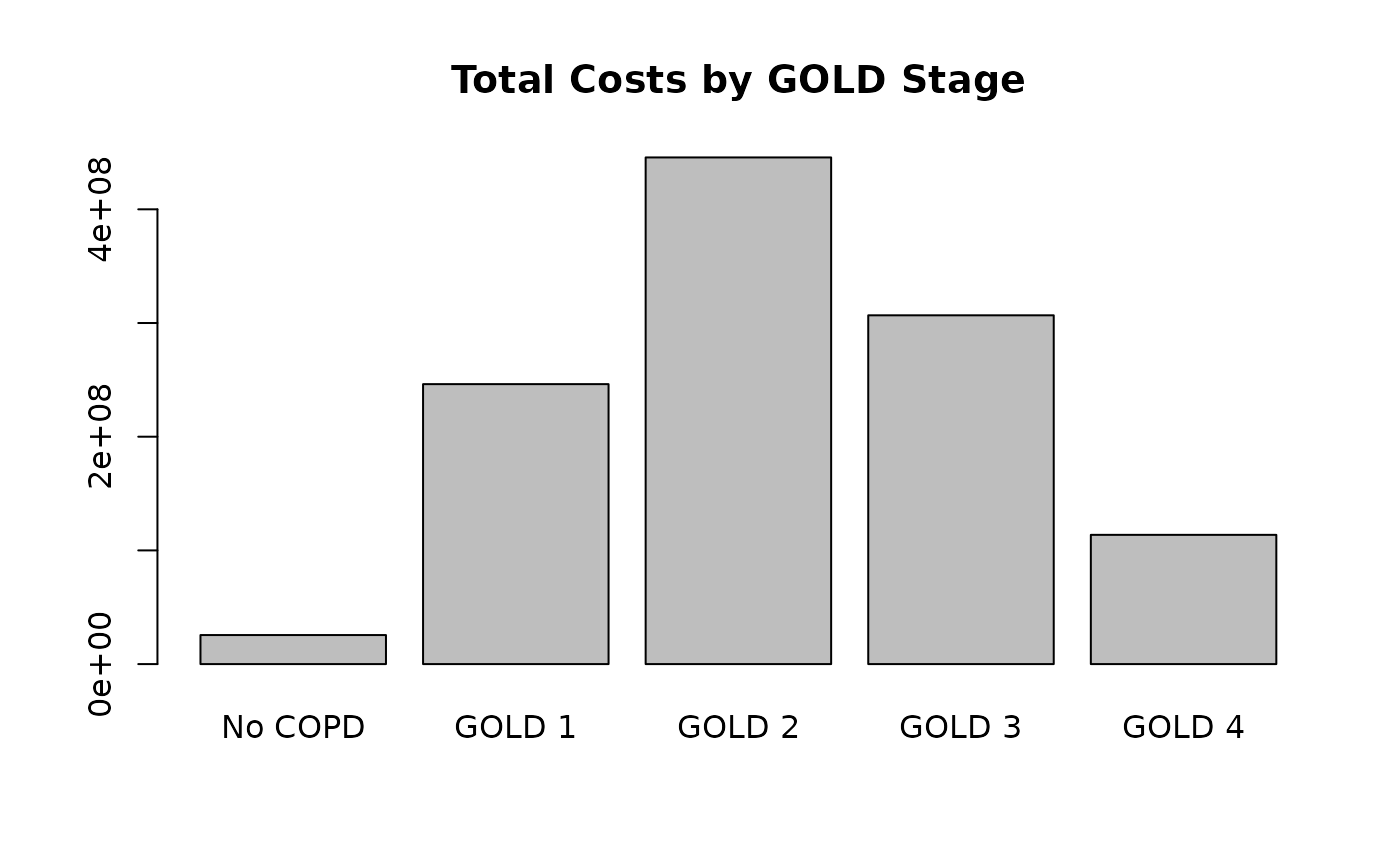
Event History (results$events)
For detailed agent-level analysis, you can capture the complete event
history by setting return_events = TRUE.
Note: Event recording requires significant memory. Use with caution for large simulations.
# Run simulation with event recording
results <- simulate(
  n_agents = 10000,
  return_events = TRUE
)
#> === EPIC Simulation Configuration ===
#> Jurisdiction: CANADA
#> Time horizon: 20 years
#> Number of agents: 10,000
#> Event recording: ENABLED (record_mode = 2)
#> Estimated memory for events: 236.6 MB
#> =====================================
#>
#> Starting simulation...
#> No active session - initializing automatically
#> Initializing the session
#> Working directory: /home/runner/work/epicR/epicR/vignettes
#> Running EPIC model (with custom input parameters)
#> Record mode: record_mode_event (2)
#> Simulating 10000 base agents: 10% 20% 30% 40% 50%
#> 60% 70% 80% 90% 100%
#> Simulation completed in 0.6 seconds
#> Collecting results...
#> Collecting extended results...
#> Collecting event history...
#> Terminating the session
#> Done!

# Access events data frame
events <- results$events
head(events)
#>   id local_time female time_at_creation age_at_creation pack_years gold event
#> 1  0          0      1                0        55.96222   7.339911    0     0
#> 2  0          1      1                0        55.96222   7.339911    0     1
#> 3  0          2      1                0        55.96222   7.339911    0     1
#> 4  0          3      1                0        55.96222   7.339911    0     1
#> 5  0          4      1                0        55.96222   7.339911    0     1
#> 6  0          5      1                0        55.96222   7.339911    0     1
#>   FEV1 FEV1_slope FEV1_acceleration pred_FEV1 smoking_status localtime_at_COPD
#> 1    0          0                 0         0              0                 0
#> 2    0          0                 0         0              0                 0
#> 3    0          0                 0         0              0                 0
#> 4    0          0                 0         0              0                 0
#> 5    0          0                 0         0              0                 0
#> 6    0          0                 0         0              0                 0
#>   age_at_COPD weight_at_COPD   height followup_after_COPD FEV1_baseline
#> 1           0              0 1.603244                   0      2.949413
#> 2           0              0 1.603244                   0      2.949413
#> 3           0              0 1.603244                   0      2.949413
#> 4           0              0 1.603244                   0      2.949413
#> 5           0              0 1.603244                   0      2.949413
#> 6           0              0 1.603244                   0      2.949413
#>   exac_status cough phlegm wheeze dyspnea gpvisits diagnosis medication_status
#> 1           0     0      0      0       1        0         0                 0
#> 2           0     1      0      1       0        3         0                 0
#> 3           0     0      0      1       1        1         0                 0
#> 4           0     0      1      1       0        4         0                 0
#> 5           0     0      0      0       0        6         0                 0
#> 6           0     0      1      1       1        4         0                 0
#>   case_detection cumul_cost cumul_qaly time_at_diagnosis
#> 1              0          0  0.0000000                 0
#> 2              0          0  0.8349515                 0
#> 3              0          0  1.6455839                 0
#> 4              0          0  2.4326058                 0
#> 5              0          0  3.1967046                 0
#> 6              0          0  3.9385482                 0
#>   exac_history_n_moderate exac_history_n_severe_plus
#> 1                       0                          0
#> 2                       0                          0
#> 3                       0                          0
#> 4                       0                          0
#> 5                       0                          0
#> 6                       0                          0
Event Matrix Columns (33 columns)
| Column | Description |
|---|---|
id |
Unique agent identifier |
local_time |
Time since agent creation (years) |
female |
Sex (0=male, 1=female) |
time_at_creation |
Calendar time when agent entered model |
age_at_creation |
Age when agent entered model |
pack_years |
Cumulative pack-years of smoking |
gold |
GOLD stage (0=no COPD, 1-4=GOLD stages) |
event |
Event type code (see table below) |
FEV1 |
Current FEV1 value (liters) |
FEV1_slope |
FEV1 decline slope |
FEV1_acceleration |
FEV1 decline acceleration |
pred_FEV1 |
Predicted FEV1 based on age/height/sex |
smoking_status |
Current smoking status (0=not smoking, 1=smoking) |
localtime_at_COPD |
Local time when COPD developed |
age_at_COPD |
Age when COPD developed |
weight_at_COPD |
Weight when COPD developed |
height |
Height (meters) |
followup_after_COPD |
Time since COPD onset |
FEV1_baseline |
FEV1 at COPD onset |
exac_status |
Current exacerbation status (0=none, 1-4=severity) |
cough |
Cough symptom present (0/1) |
phlegm |
Phlegm symptom present (0/1) |
wheeze |
Wheeze symptom present (0/1) |
dyspnea |
Dyspnea symptom present (0/1) |
gpvisits |
Annual number of GP visits |
diagnosis |
Diagnosis status (0=undiagnosed, 1=diagnosed) |
medication_status |
Medication class bitfield |
case_detection |
Case detection received (0/1) |
cumul_cost |
Cumulative cost for this agent |
cumul_qaly |
Cumulative QALYs for this agent |
time_at_diagnosis |
Local time when diagnosed |
exac_history_n_moderate |
Cumulative count of moderate exacerbations |
exac_history_n_severe_plus |
Cumulative count of severe and very severe exacerbations |
Event Type Codes
| Event | Code | Description |
|---|---|---|
| Start | 0 | Agent creation |
| Annual | 1 | Annual update (fixed time event) |
| Birthday | 2 | Birthday event (currently disabled) |
| Smoking change | 3 | Smoking status change (start or quit) |
| COPD incidence | 4 | New COPD diagnosis |
| Exacerbation | 5 | Exacerbation onset |
| Exacerbation end | 6 | Exacerbation resolution |
| Death by exacerbation | 7 | Death during exacerbation |
| Doctor visit | 8 | Doctor visit (not implemented) |
| Medication change | 9 | Medication change (not implemented) |
| Background death | 13 | Death from background causes |
| End | 14 | End of follow-up |
# Analyze events for a specific agent
results <- simulate(n_agents = 10000, return_events = TRUE)
#> === EPIC Simulation Configuration ===
#> Jurisdiction: CANADA
#> Time horizon: 20 years
#> Number of agents: 10,000
#> Event recording: ENABLED (record_mode = 2)
#> Estimated memory for events: 236.6 MB
#> =====================================
#>
#> Starting simulation...
#> No active session - initializing automatically
#> Initializing the session
#> Working directory: /home/runner/work/epicR/epicR/vignettes
#> Running EPIC model (with custom input parameters)
#> Record mode: record_mode_event (2)
#> Simulating 10000 base agents: 10% 20% 30% 40% 50%
#> 60% 70% 80% 90% 100%
#> Simulation completed in 0.6 seconds
#> Collecting results...
#> Collecting extended results...
#> Collecting event history...
#> Terminating the session
#> Done!
events <- results$events

# Get all events for agent #5
agent_5_events <- events[events$id == 5, ]
print(agent_5_events[, c("local_time", "event", "gold", "exac_status")])
#>    local_time event gold exac_status
#> 92   0.000000     0    0           0
#> 93   1.000000     1    0           0
#> 94   2.000000     1    0           0
#> 95   3.000000     1    0           0
#> 96   4.000000     1    0           0
#> 97   4.626367    13    0           0
#> 98   4.626367    14    0           0

# Count events by type
event_counts <- table(events$event)
names(event_counts) <- c("Start", "Annual", "Birthday", "Smoking",
                         "COPD", "Exac", "Exac_end", "Exac_death",
                         "Doctor", "Med_change", "", "", "",
                         "Bgd_death", "End")[as.numeric(names(event_counts)) + 1]
print(event_counts)
#>      Start     Annual    Smoking       COPD       Exac   Exac_end Exac_death
#>      16071     210981       2995        959      13155      12979        156
#>  Bgd_death        End
#>       3251      16071

# Find all exacerbation events
exac_events <- events[events$event == 5, ]
cat("Total exacerbations:", nrow(exac_events), "\n")
#> Total exacerbations: 13155
cat("By severity:\n")
#> By severity:
print(table(exac_events$exac_status))
#>
#>     1     2     3     4
#>  1860 10273   943    79
Record Modes
The record_mode setting controls what level of detail is
captured.
| Mode | Value | Description | Memory Usage |
|---|---|---|---|
record_mode_none |
0 | Aggregate output only | Minimal |
record_mode_agent |
1 | Agent-level summaries | Low |
record_mode_event |
2 | Complete event history | High |
record_mode_some_event |
3 | Selected event types only | Medium |
# Using settings directly
settings <- get_default_settings()
settings$record_mode <- 2  # Full event recording
settings$n_base_agents <- 10000

results <- simulate(settings = settings, return_events = TRUE)
#> === EPIC Simulation Configuration ===
#> Jurisdiction: CANADA
#> Time horizon: 20 years
#> Number of agents: 10,000
#> Event recording: ENABLED (record_mode = 2)
#> Estimated memory for events: 236.6 MB
#> =====================================
#>
#> Starting simulation...
#> No active session - initializing automatically
#> Initializing the session
#> Working directory: /home/runner/work/epicR/epicR/vignettes
#> Running EPIC model (with custom input parameters)
#> Record mode: record_mode_event (2)
#> Simulating 10000 base agents: 10% 20% 30% 40% 50%
#> 60% 70% 80% 90% 100%
#> Simulation completed in 0.6 seconds
#> Collecting results...
#> Collecting extended results...
#> Collecting event history...
#> Terminating the session
#> Done!

# Or simply use return_events = TRUE (automatically sets record_mode = 2)
results <- simulate(n_agents = 10000, return_events = TRUE)
#> === EPIC Simulation Configuration ===
#> Jurisdiction: CANADA
#> Time horizon: 20 years
#> Number of agents: 10,000
#> Event recording: ENABLED (record_mode = 2)
#> Estimated memory for events: 236.6 MB
#> =====================================
#>
#> Starting simulation...
#> No active session - initializing automatically
#> Initializing the session
#> Working directory: /home/runner/work/epicR/epicR/vignettes
#> Running EPIC model (with custom input parameters)
#> Record mode: record_mode_event (2)
#> Simulating 10000 base agents: 10% 20% 30% 40% 50%
#> 60% 70% 80% 90% 100%
#> Simulation completed in 0.6 seconds
#> Collecting results...
#> Collecting extended results...
#> Collecting event history...
#> Terminating the session
#> Done!
Complete Example: Cost-Effectiveness Analysis
# Baseline scenario
input_baseline <- get_input(jurisdiction = "canada")
results_baseline <- simulate(
  input = input_baseline$values,
  n_agents = 50000,
  seed = 12345  # For reproducibility
)
#> Random seed set to: 12345
#> === EPIC Simulation Configuration ===
#> Jurisdiction: CANADA
#> Time horizon: 20 years
#> Number of agents: 50,000
#> Event recording: DISABLED
#> =====================================
#>
#> Starting simulation...
#> No active session - initializing automatically
#> Initializing the session
#> Working directory: /home/runner/work/epicR/epicR/vignettes
#> Running EPIC model (with custom input parameters)
#> Record mode: record_mode_none (0)
#> Note: No events will be recorded. Use record_mode_event (2) or record_mode_agent (1) to record events.
#> Simulating 50000 base agents: 10% 20% 30% 40% 50%
#> 60% 70% 80% 90% 100%
#> Simulation completed in 2.7 seconds
#> Collecting results...
#> Collecting extended results...
#> Terminating the session
#> Done!

# Intervention scenario: Enhanced smoking cessation
input_intervention <- get_input(jurisdiction = "canada")
input_intervention$values$smoking$ln_h_ces_betas[1] <-
  input_intervention$values$smoking$ln_h_ces_betas[1] + 0.5

results_intervention <- simulate(
  input = input_intervention$values,
  n_agents = 50000,
  seed = 12345  # Same seed for comparability
)
#> Random seed set to: 12345
#> === EPIC Simulation Configuration ===
#> Jurisdiction: CANADA
#> Time horizon: 20 years
#> Number of agents: 50,000
#> Event recording: DISABLED
#> =====================================
#>
#> Starting simulation...
#> No active session - initializing automatically
#> Initializing the session
#> Working directory: /home/runner/work/epicR/epicR/vignettes
#> Running EPIC model (with custom input parameters)
#> Record mode: record_mode_none (0)
#> Note: No events will be recorded. Use record_mode_event (2) or record_mode_agent (1) to record events.
#> Simulating 50000 base agents: 10% 20% 30% 40% 50%
#> 60% 70% 80% 90% 100%
#> Simulation completed in 2.6 seconds
#> Collecting results...
#> Collecting extended results...
#> Terminating the session
#> Done!

# Calculate incremental cost-effectiveness
delta_cost <- results_intervention$basic$total_cost - results_baseline$basic$total_cost
delta_qaly <- results_intervention$basic$total_qaly - results_baseline$basic$total_qaly
icer <- delta_cost / delta_qaly

cat("Baseline total cost:", results_baseline$basic$total_cost, "\n")
#> Baseline total cost: 172264913
cat("Intervention total cost:", results_intervention$basic$total_cost, "\n")
#> Intervention total cost: 172900256
cat("Baseline total QALYs:", results_baseline$basic$total_qaly, "\n")
#> Baseline total QALYs: 689014.9
cat("Intervention total QALYs:", results_intervention$basic$total_qaly, "\n")
#> Intervention total QALYs: 689888.7
cat("Incremental cost:", delta_cost, "\n")
#> Incremental cost: 635343.7
cat("Incremental QALYs:", delta_qaly, "\n")
#> Incremental QALYs: 873.8044
cat("ICER:", icer, "per QALY\n")
#> ICER: 727.1006 per QALY
Important Notes
- Starting Age: EPIC only simulates patients starting at age 40
- Comorbidities: Cardiovascular comorbidities (MI, stroke, heart failure) are not implemented in the current version
- Memory: Event recording can require substantial memory for large simulations
-
Reproducibility: Use the
seedparameter for reproducible results -
Discounting: Costs and QALYs are discounted at the
rates specified in
global_parameters